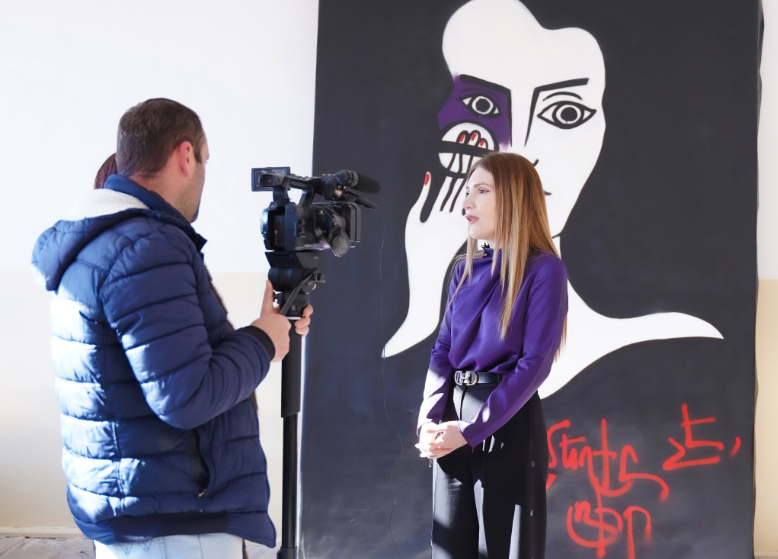
On 19 December 2024, the “Open Borders” Institute for Peace, Democracy and Development (OBI) held the unveiling ceremony of a mural entitled “It’s Not Your Fault, Don’t Stay Silent”, an artistic initiative dedicated to raising awareness about and preventing violence against women and girls.
More than an artistic intervention in public space, the mural represents a clear and powerful message: violence is never the survivor’s fault, silence should never be a condition of survival, and every individual and institution has a responsibility to contribute to a society in which women and girls can live free from violence, fear and discrimination.
The unveiling ceremony brought together representatives of educational institutions, law enforcement agencies, civil society organisations, local government bodies and the media. Their participation reflected the importance of a coordinated, cross-sectoral approach to preventing violence and strengthening the systems responsible for protecting the rights and dignity of women and girls.
Breaking the Silence Through Art and Public Engagement
The mural was conceived as a visible and lasting reminder that preventing violence requires more than responding to individual incidents. It requires changing social attitudes, challenging harmful stereotypes, addressing victim-blaming and creating an environment in which survivors feel safe to seek support and report abuse.
The message “It’s Not Your Fault, Don’t Stay Silent” addresses two interconnected challenges: the tendency to place responsibility for violence on those who experience it and the social pressures that often discourage survivors from speaking out. By placing this message in a shared public space, OBI sought to make the issue more visible and encourage open conversations within the community.
Art has the capacity to communicate complex social issues in an accessible and emotionally meaningful way. Unlike a formal awareness campaign or institutional statement, a mural becomes part of people’s everyday environment. It invites reflection, challenges indifference and creates an opportunity for conversations that might otherwise remain unspoken.
During the ceremony, Arev Baghdasaryan, head of an educational institution, highlighted the significance of the mural for the community. In her remarks, she emphasised that the artwork is not simply an expression of creativity, but a meaningful social statement that encourages people to stand against silence and support those affected by violence, particularly women and girls.
Ruben Muradyan, representing law enforcement, underlined the important contribution of civil society organisations to violence prevention. He also emphasised the value of initiatives that use creative and public engagement approaches to strengthen awareness, encourage collective responsibility and support efforts to combat violence against women.
A Shared Responsibility: From Awareness to Action
Addressing the participants, Eleonora Begoyan, President of the “Open Borders” Institute for Peace, Democracy and Development, reaffirmed the organisation’s commitment to protecting human rights and advancing gender equality.
She emphasised that the prevention of violence must remain a continuous and collective effort, extending beyond responding to its consequences. Sustainable change requires early prevention, public awareness, accessible support mechanisms, institutional accountability and effective cooperation among all relevant stakeholders.
For OBI, combating violence against women and girls is not limited to individual interventions or awareness-raising activities. It is part of a broader commitment to strengthening human rights protection, promoting gender-responsive institutions and ensuring that survivors are treated with dignity, respect and understanding.
The organisation recognises that meaningful progress depends on the ability of communities and institutions to identify violence, respond appropriately and prevent further harm, including secondary victimisation. This requires the engagement of educators, law enforcement professionals, public authorities, social service providers, civil society and the wider public.
Personal Messages Against Violence
One of the most meaningful moments of the event was a participatory activity in which guests were invited to write short letters expressing their personal position against violence towards women and girls.
Each letter reflected a different perspective and personal commitment. Participants wrote as mothers, fathers, wives, family members and, above all, as individuals who believe that violence has no place in society.
The messages demonstrated that opposition to violence is not exclusively the responsibility of professionals or specialised organisations. It is a shared social commitment that begins with recognising the problem, refusing to justify abusive behaviour and standing in solidarity with those who experience violence.
This activity also reinforced an essential principle: creating safer communities requires men and women alike to become active participants in challenging violence, discrimination and the social norms that allow abuse to persist.
A Lasting Message for the Community
The unveiling of “It’s Not Your Fault, Don’t Stay Silent” was more than the conclusion of an artistic initiative. It was an invitation to continue the conversation and translate awareness into meaningful action.
The mural stands as a reminder that no form of violence is acceptable, that responsibility always lies with the perpetrator and that survivors deserve protection, support and access to justice — never blame or judgment.
Through initiatives that combine public engagement, artistic expression, institutional cooperation and human rights advocacy, the “Open Borders” Institute continues to promote a culture in which violence is recognised, challenged and prevented.
The message of the mural is simple, but its meaning is profound: it is never your fault. You are not alone. You have the right to speak, to be heard and to live free from violence. And building a society where these rights are respected is a responsibility we all share.