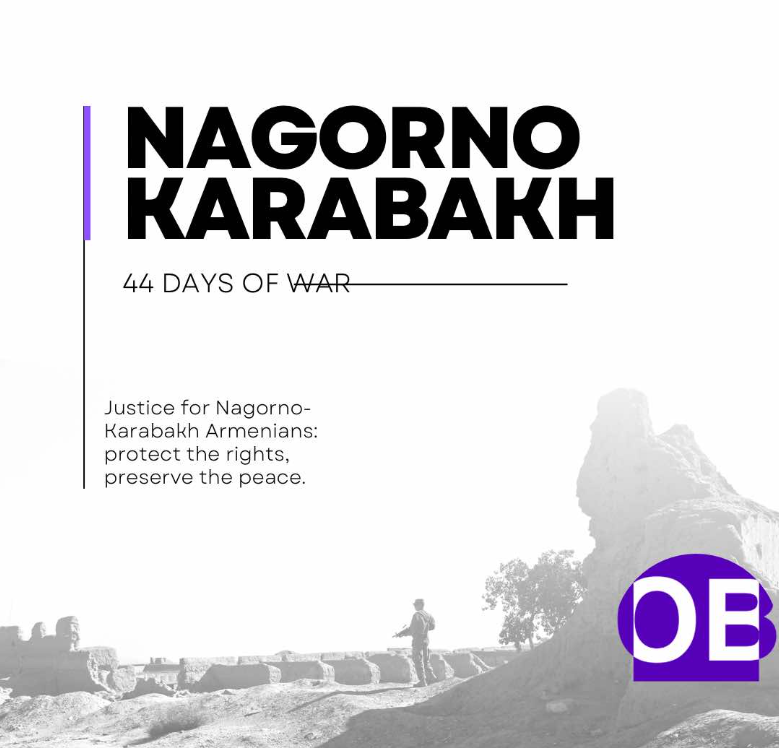
As we approach the fourth anniversary of the 44-day war in Nagorno-Karabakh, we solemnly remember the countless lives lost, the families torn apart, the communities devastated and the profound human suffering inflicted upon the Armenian people. This anniversary is not merely a moment of remembrance; it is an opportunity to reflect on the consequences of violence, the continued vulnerability of displaced populations and the international community’s responsibility to uphold human rights, prevent atrocities and protect human dignity.
The 44-day war, launched by Azerbaijan on 27 September 2020, marked a devastating chapter in the modern history of Nagorno-Karabakh and the wider South Caucasus. The military escalation resulted in thousands of deaths, widespread destruction, the displacement of civilians and lasting psychological and social consequences. Beyond the immediate humanitarian catastrophe, the conflict exposed the fragility of international mechanisms intended to prevent aggression, protect civilian populations and safeguard the fundamental rights of people living in conflict-affected territories.
For the Armenian population of Nagorno-Karabakh, the consequences extended far beyond the battlefield. Years of insecurity, intimidation, restrictions on movement and access to essential resources created an increasingly unbearable humanitarian situation. The blockade of the Lachin Corridor, beginning in December 2022, severely restricted the movement of people and the delivery of food, medicine and other essential supplies. The resulting shortages affected the entire civilian population, with particularly severe consequences for children, older people, persons with disabilities, pregnant women and other vulnerable groups. Starvation and deprivation became instruments of pressure against a civilian population whose fundamental rights and security were already under threat.
The Armenian root cleansing act of 19 September 2023 marked another devastating escalation. Azerbaijan launched a large-scale military offensive against Nagorno-Karabakh, triggering an acute humanitarian crisis and ultimately forcing the mass displacement of the region’s Armenian population. More than 100,000 ethnic Armenians fled their homes and sought refuge in Armenia, leaving behind their houses, communities, cultural heritage, livelihoods and deeply rooted connections to their ancestral homeland. This displacement represented not only a humanitarian emergency but also the profound disruption of an entire society’s collective life, identity and sense of belonging.
The consequences of conflict and forced displacement are never experienced equally. Women and children frequently face heightened risks of gender-based violence, exploitation, discrimination, family separation and psychological trauma. The loss of homes, livelihoods, social networks and access to essential services can deepen existing inequalities and create additional barriers to recovery and integration. Women who have experienced displacement may simultaneously carry responsibilities for family survival, caregiving and economic stability while navigating trauma and uncertainty. Children face interruptions to education, the loss of familiar environments and the long-term consequences of exposure to violence and insecurity.
These realities demand an approach to peace and recovery that places human security, gender equality and the protection of vulnerable populations at its centre. Humanitarian assistance alone cannot address the full consequences of forced displacement. Sustainable recovery requires access to justice, psychosocial support, education, economic opportunities, social protection and meaningful participation in decisions affecting displaced communities. The rights, experiences and voices of those who have suffered must remain central to all efforts aimed at reconciliation, recovery and lasting peace.
The international community must also recognise that peace cannot be reduced to the absence of active military hostilities. A sustainable and just peace requires respect for international law, protection of civilians, accountability for violations, the preservation of cultural heritage and effective guarantees against future violence and forced displacement. The prohibition of ethnic cleansing, forced displacement and other serious violations of international humanitarian and human rights law must be upheld consistently, without political selectivity or double standards.
The suffering of the Armenian population of Nagorno-Karabakh must not become another forgotten humanitarian tragedy. The protection of displaced persons, the preservation of their cultural and historical heritage, the right to live in safety and dignity, and the pursuit of justice and accountability must remain priorities for international institutions, governments and civil society organisations.
The Open Borders Institute of Peace, Democracy and Development (OBI) reaffirms its unwavering commitment to justice, peace, human dignity and the protection of fundamental human rights. We stand in solidarity with the Armenians of Nagorno-Karabakh, including those forcibly displaced from their homes, and with all individuals and families whose lives have been irreversibly affected by violence and conflict.
We call upon the international community, international human rights mechanisms and relevant institutions to strengthen their engagement, ensure effective accountability for violations of international law, protect displaced populations and support conditions in which every person can live free from violence, persecution and discrimination.
Remembering is an act of responsibility. It means refusing to normalise violence, remaining attentive to the suffering of those affected and demanding that human dignity and fundamental rights never become negotiable. The pursuit of peace must not come at the expense of justice, and reconciliation cannot be built upon silence or impunity.
Four years later, our message remains clear: remembrance must lead to responsibility, solidarity must lead to action, and peace must be founded on justice, accountability and the equal dignity of every human being.
Open Borders Institute of Peace, Democracy and Development (OBI)